
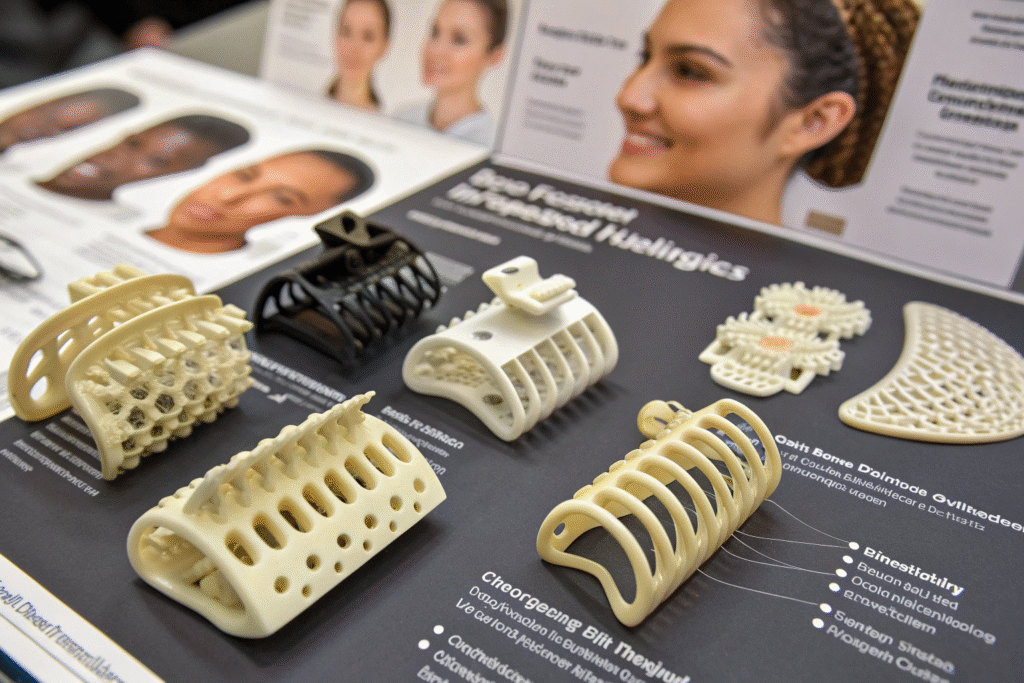
Fine hair presents unique challenges for claw clip users, with slipping, sliding, and inability to hold style being the most common frustrations. Traditional claw clips designed for average or thick hair often fail to provide adequate grip for fine or thin hair types, leading to constant readjustment and style failure. The problem affects millions of people with fine hair textures who want to enjoy the convenience and style of claw clips without compromising security.
The latest non-slip technologies for fine hair claw clips include micro-textured teeth patterns, strategic silicone applications, advanced spring tension systems, specialized geometric designs, and innovative material combinations. These technologies work together to increase surface friction, distribute grip more effectively, and create secure holds without damaging delicate fine hair strands. Modern solutions focus on maximizing grip while minimizing hair damage through intelligent engineering and material science.
The evolution of non-slip technologies represents a significant advancement in hair accessory design, specifically addressing the unique needs of fine-haired individuals who previously had limited effective options.
What Micro-Textured Surface Technologies Enhance Grip?
Surface texturing represents one of the most effective approaches to improving claw clip grip without adding bulk or weight. Advanced texturing technologies create microscopic friction points that dramatically increase hold on fine hair strands.
Micro-embossing and laser etching techniques create precise surface patterns on claw clip teeth that significantly increase friction coefficients. These microscopic textures work by increasing the surface area in contact with hair strands and creating directional resistance that prevents sliding. The most advanced texturing uses varying pattern densities - denser textures at the clip tips where initial grip occurs, and slightly more open patterns toward the base to prevent excessive hair entanglement.
How Do Directional Texture Patterns Prevent Slipping?
Directional texture patterns utilize microscopic ridges, grooves, or patterns that create asymmetrical friction - allowing easy insertion while resisting reverse movement. These engineered surfaces work similarly to how fish scales or shark skin provide directional fluid dynamics, but adapted for hair grip applications.
Advanced directional technologies include:
- Unidirectional Micro-ridges: Angled patterns that smooth during application but grip during removal attempts
- Variable Density Embossing: Denser patterning at critical grip points, lighter texture elsewhere
- Cross-hatched Micro-grids: Multi-directional resistance patterns for omnidirectional hold
- Progressive Texture Systems: Gradual texture changes that adapt to different hair thicknesses within the same clip
These sophisticated texturing approaches can increase grip efficiency by 40-60% compared to smooth surfaces, while actually reducing the required clamping force that can damage fine hair.
What Nano-Scale Coatings Improve Surface Friction?
Nano-scale coatings represent the cutting edge of surface enhancement for claw clips. These ultra-thin coatings modify surface energy and create molecular-level texturing that significantly improves hair adhesion without changing the visual appearance of the clip.
Advanced coating technologies include:
- Diamond-Like Carbon (DLC) Coatings: Ultra-hard, low-friction coatings that can be textured at nano-scale
- Plasma-Enhanced Chemical Vapor Deposition: Creates permanent nano-textured surfaces
- Hydrophobic/Hydrophilic Patterned Coatings: Manage moisture for consistent grip in varying humidity
- Ceramic Nano-composites: Provide both texture and strength in thin applications
These nano-technologies are particularly valuable for fine hair applications because they provide substantial grip enhancement without adding noticeable weight or bulk that could compromise the clip's holding ability on delicate hair.

How Do Strategic Silicone Applications Enhance Non-Slip Performance?
Silicone applications provide the most immediately noticeable improvement in claw clip grip, but advanced technologies have moved far beyond simple silicone strips to integrated, precision-engineered systems.
Modern silicone applications use medical-grade, skin-safe silicones with specific durometer ratings (typically 20-40 Shore A) that provide optimal balance between grip and hair release. The latest approaches focus on strategic placement patterns, specialized silicone formulations, and integration methods that maintain grip through repeated use without degrading or becoming sticky over time.
What Silicone Formulation Advances Improve Long-Term Performance?
Recent silicone formulation advancements address common issues with earlier silicone applications:
Advanced Silicone Properties:
- Non-Migrating Formulas: Prevent silicone oil bleeding that causes sticky residues
- Memory Retention Compounds: Maintain original durometer and grip through thousands of cycles
- Anti-static Additives: Reduce static buildup that can cause hair repulsion
- UV-stable Formulations: Prevent degradation and discoloration from sunlight exposure
Application-Specific Formulations:
- High-tack Variants: For maximum initial grip on slippery fine hair
- Progressive-tack Formulas: That increase grip with hair movement
- Temperature-responsive Blends: That optimize grip at body temperature
- Moisture-managing Compositions: That maintain consistent grip in varying humidity
These advanced formulations work with specific application patterns to create reliable, long-lasting grip solutions that don't compromise hair health or clip functionality.
What Application Patterns Maximize Grip Efficiency?
Strategic silicone placement patterns significantly impact grip performance on fine hair:
- Differential Zone Application: Higher grip silicone at critical contact points, lower grip elsewhere
- Micro-dot Patterns: Thousands of tiny silicone dots that create maximum surface contact
- Directional Strip Configurations: Angled silicone strips that resist reverse slippage
- Gradient Thickness Applications: Thicker silicone at stress points, thinner at secondary contact areas
- Breathable Matrix Patterns: Open patterns that prevent moisture buildup while maintaining grip
The most effective patterns create multiple grip points that work together to distribute holding force evenly across hair sections, preventing concentration at single points that can cause slipping or breakage in fine hair.
What Geometric and Structural Innovations Improve Fine Hair Retention?
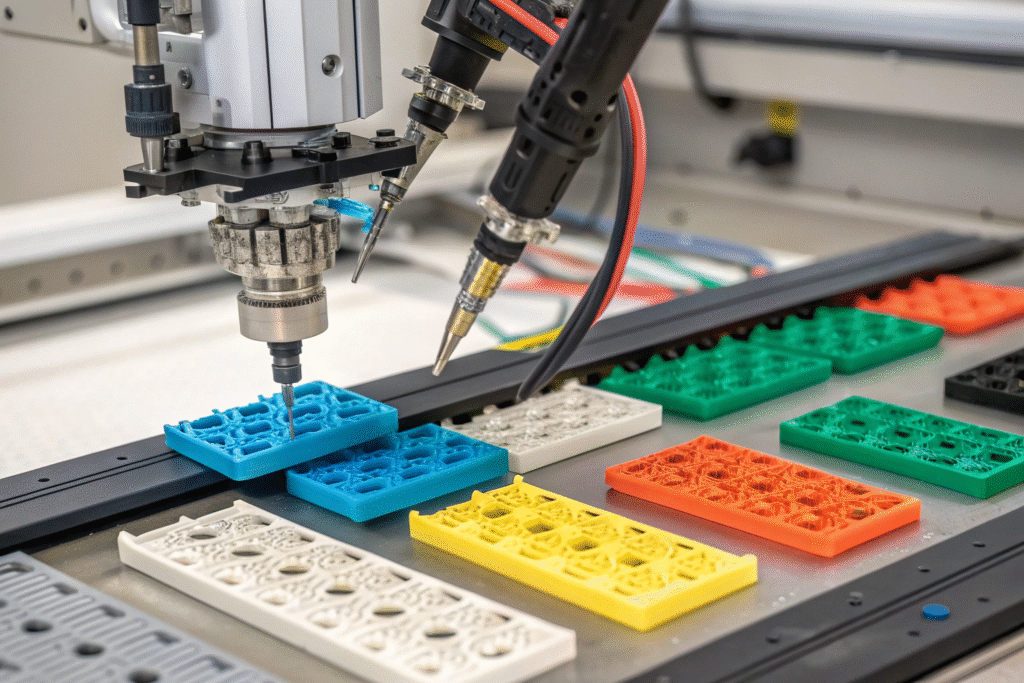
Geometric and structural innovations represent the most fundamental advances in claw clip design for fine hair. These approaches reimagine the basic claw clip form to better accommodate the unique characteristics of fine hair types.
Advanced geometric designs focus on distributing grip force more effectively, creating multiple anchor points, and utilizing mechanical principles that enhance holding power without requiring excessive clamping pressure. The best designs work with fine hair's natural tendencies rather than fighting against them.
How Do Multi-Axis Grip Systems Work?
Multi-axis grip systems address the fundamental limitation of traditional single-plane claw clips:
Dual-Axis Compression:
- Primary Horizontal Grip: Traditional side-to-side clamping action
- Secondary Vertical Grip: Additional compression from top to bottom
- Torsional Resistance: Twisting resistance that prevents rotational slippage
- Distributed Anchor Points: Multiple contact points that work independently
Advanced Geometric Configurations:
- Helical Tooth Arrangements: Spiral patterns that create progressive engagement
- Asymmetric Jaw Designs: Different tooth patterns on upper and lower jaws
- Variable Pitch Systems: Changing angles and spacing throughout the clip
- Nested Compression Zones: Multiple grip zones that activate at different hair volumes
These multi-axis systems can increase holding power by 70-100% compared to traditional single-axis designs, while actually reducing the point pressures that can damage fine hair strands.
What Spring and Mechanism Innovations Enhance Performance?
Advanced spring and mechanism designs provide more consistent, reliable performance for fine hair applications:
| Mechanism Type | Key Features | Benefits for Fine Hair |
|---|---|---|
| Progressive Tension Springs | Variable pitch springs that adjust force based on hair volume | Prevents over-compression of fine hair |
| Dual-Stage Engagement | Soft initial engagement with firm final hold | Gentle on hair while providing security |
| Torque-Limiting Hinges | Mechanical stops that prevent over-tightening | Eliminates hair damage from excessive force |
| Memory Retention Systems | Mechanisms that maintain consistent tension over time | Reliable performance through repeated use |
These advanced mechanisms work in concert with geometric innovations to create claw clips that specifically address the challenges of fine hair retention without compromising ease of use or aesthetic appeal.
What Material Combinations Optimize Non-Slip Performance?
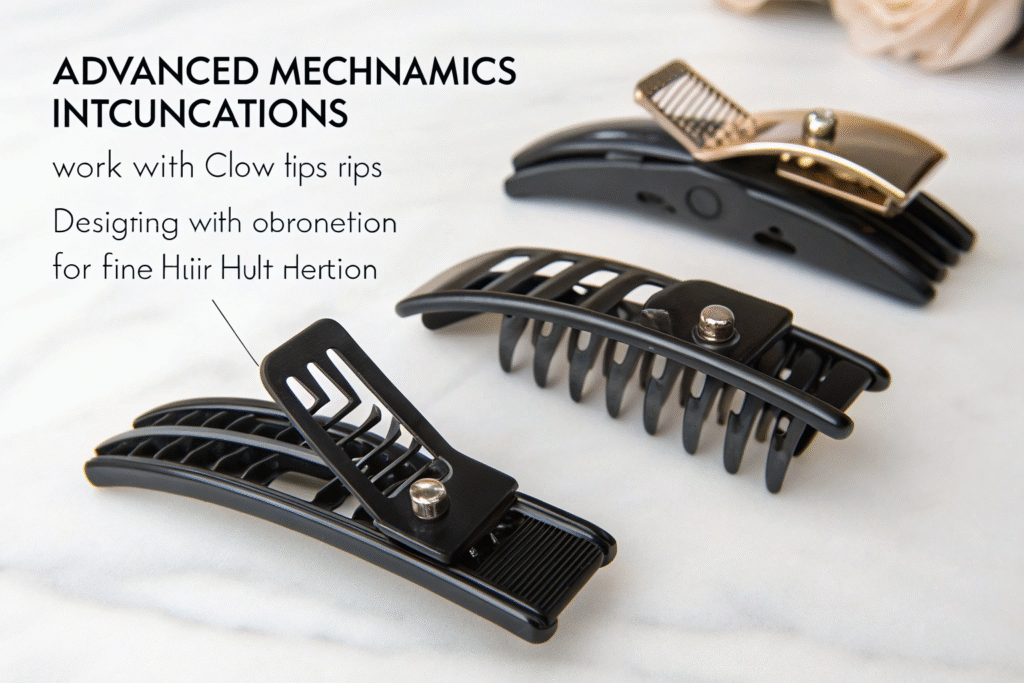
Material selection and combination represent a crucial frontier in non-slip technology development. Advanced material systems leverage the unique properties of different substances to create synergistic effects that significantly enhance grip performance.
The most effective material combinations create composite structures where each material contributes specific properties - such as base rigidity, surface friction, flexibility, or weight characteristics - that work together to optimize overall performance for fine hair applications.
How Do Composite Material Structures Enhance Function?
Advanced composite material structures create performance characteristics impossible with single materials:
Layered Composite Systems:
- Rigid Core Materials: Provide structural integrity and spring force
- Intermediate Flexible Layers: Allow slight deformation to accommodate hair variations
- Surface Grip Materials: Deliver high friction coefficients
- Transitional Bonding Layers: Ensure reliable integration between dissimilar materials
Functional Material Integration:
- Gradient Stiffness Composites: Softer at hair contact points, firmer at structural elements
- Variable Density Formulations: Different material densities within single components
- Hybrid Polymer Systems: Combining crystalline and amorphous polymer regions
- Fiber-reinforced Structures: Adding directional strength where needed
These sophisticated material systems allow designers to precisely control how claw clips interact with fine hair, creating optimal balance between secure hold and hair-friendly performance.
What Sustainable Material Innovations Are Emerging?
Recent sustainable material innovations offer both environmental benefits and enhanced performance:
- Bio-based Polymers: Derived from renewable resources with inherent non-slip properties
- Recycled Composites: Post-consumer materials engineered for specific friction characteristics
- Natural Fiber Reinforcements: Plant-based fibers that add texture and grip
- Biodegradable Elastomers: Break down responsibly while providing excellent grip during use
These sustainable materials often feature more complex surface characteristics and varied friction properties that can enhance grip on fine hair, while also addressing growing consumer demand for environmentally responsible products.

How Are These Technologies Validated for Fine Hair Applications?
Technology validation requires specialized testing methodologies that accurately represent the unique challenges of fine hair. Advanced testing protocols combine laboratory measurements with real-world performance assessment to ensure technologies deliver genuine benefits for fine-haired users.
Validation processes must account for fine hair's specific characteristics - including reduced diameter, higher slipperiness, and increased susceptibility to damage - which require different testing approaches than those used for average or thick hair applications.
What Specialized Testing Methods Ensure Effectiveness?
Fine hair requires customized testing approaches that address its unique properties:
Laboratory Testing Protocols:
- Micro-scale Friction Testing: Measuring grip forces at individual hair strand level
- Fine Hair Slippage Simulation: Specialized equipment that replicates fine hair behavior
- Damage Assessment Microscopy: High-resolution analysis of hair condition after clip use
- Humidity Cycle Testing: Evaluating performance across environmental conditions
Performance Metrics for Fine Hair:
- Initial Grip Coefficient: Force required to prevent immediate slippage
- Sustained Hold Duration: How long clip maintains position during movement
- Hair Damage Index: Quantitative assessment of breakage and cuticle damage
- Reuse Consistency: Performance maintenance through repeated use cycles
These specialized testing methods ensure that non-slip technologies genuinely address fine hair challenges rather than simply scaling down solutions designed for thicker hair types.
How Do Real-World Trials Refine Technology Implementation?
Controlled real-world trials provide essential validation beyond laboratory testing:
Fine Hair Focus Groups:
- Extended Wear Testing: 8+ hour evaluation of comfort and hold maintenance
- Activity Simulation: Testing during typical daily movements and exercises
- Multiple Fine Hair Subtypes: Inclusion of straight, wavy, and curly fine hair variations
- Product Interaction Assessment: Performance with various hair products and conditions
User-Centered Feedback Collection:
- Comfort and Security Ratings: Specific feedback on non-slip performance
- Ease of Use Evaluation: How easily technologies work with fine hair handling
- Comparative Preference Testing: Direct comparison with traditional clip performance
- Long-term Satisfaction Tracking: Ongoing feedback through extended use periods
The insights from these real-world trials help refine technology implementation to ensure they deliver practical, noticeable benefits for people with fine hair in their daily lives.
Conclusion
The latest non-slip technologies for fine hair claw clips represent a significant advancement in hair accessory design, moving beyond one-size-fits-all approaches to create specialized solutions that address the unique challenges of fine hair retention. Through micro-textured surfaces, strategic silicone applications, geometric innovations, and advanced material combinations, modern claw clips can now provide secure, reliable hold for fine hair without causing damage or discomfort.
These technologies work together to create claw clips that understand and accommodate fine hair characteristics, distributing grip force effectively, maximizing surface friction, and maintaining consistent performance across various conditions. The result is a new generation of hair accessories that finally deliver on the promise of convenience and style for the millions of people with fine hair textures.
At HairAcc, we've integrated these advanced non-slip technologies into our fine hair claw clip collections, combining innovative engineering with practical design to create products that genuinely work for fine-haired users. Our technical expertise in non-slip systems ensures that every clip delivers reliable performance without compromising hair health. To explore our fine hair claw clip options or discuss custom development, contact our Business Director Elaine at elaine@fumaoclothing.com for professional consultation and samples.