

When retailers source fashion hair accessories, they often face unpredictable quality, shipment delays, and compliance risks that can damage brand reputation. For example, a retailer ordering 50,000 hair clips from an uncertified supplier may receive products with weak clasps, uneven coatings, or mislabeled packaging. These issues create costly returns, dissatisfied customers, and strained relationships with distributors. Without a structured quality management system, even large orders may turn into liabilities instead of profitable sales.
Working with an ISO 9001-certified hair clip manufacturer prevents these risks. Certification ensures that every step of the process—from design to production to inspection—is monitored, documented, and continuously improved. This means each hair clip not only meets the buyer’s specifications but also complies with international market standards in the US, EU, and beyond. For retailers, this level of reliability translates into smoother customs clearance, stronger consumer trust, and long-term sourcing stability.
As a wholesale accessories manufacturer, I have witnessed firsthand how certification transforms business partnerships. Compliance is not just a checklist; it is a framework for building confidence between suppliers and retailers. Below, I will explain in detail why ISO 9001 certification matters, the risks of ignoring it, and how it supports large-scale retail operations.
How Does ISO 9001 Certification Guarantee Product Quality?
ISO 9001 is the most widely recognized quality management system in the world. Certified factories must implement structured processes for planning, manufacturing, inspection, and shipment. This includes traceability systems that record every material used and every test performed. For example, when producing a batch of 100,000 claw clips, an ISO-certified factory can provide batch numbers and inspection reports for each carton, ensuring accountability.
An ISO 9001-certified supplier guarantees uniformity in product dimensions, color matching, and durability. In the fashion industry, even a small variation—such as the shade of a velvet headband—can cause entire batches to be rejected. Certification eliminates such risks by standardizing every production stage, from material sourcing to final packaging.

Why does consistency matter in fashion retail?
Consistency is the foundation of brand reputation. Customers expect that every piece purchased online or in-store matches the product photo exactly. A supplier without ISO systems may deliver headbands in slightly different shades or clips with uneven tension. According to Retail Dive, inconsistent product quality accounts for over 25% of customer complaints in fashion e-commerce. Similarly, Textile World emphasizes that reliable product uniformity is critical for large retailers who manage inventories across multiple stores.
How does ISO improve inspection processes?
ISO 9001 requires structured checkpoints, including tensile strength tests for clips, fabric colorfastness testing, and drop tests for packaging. These checkpoints reduce defects by catching problems early. For example, SGS, a global inspection firm, explains that ISO-certified audits provide detailed traceability, which ensures compliance with EU REACH and US CPSIA regulations. This means retailers can avoid delays at customs and pass corporate audits more easily. SGS highlights that compliance documentation from ISO-certified suppliers accelerates approvals for global shipments.
What Compliance Risks Do Non-Certified Suppliers Pose?
Non-certified suppliers operate without strict frameworks. They may use untested dyes, low-grade metals, or informal packaging methods, which can lead to regulatory violations. A single violation may halt thousands of units at customs, damaging a retailer’s seasonal sales window. For instance, a shipment delayed during the holiday season can result in revenue losses that far exceed the original order cost.
The main risk is non-compliance with safety and labeling laws. Factories that skip testing may unknowingly produce clips containing nickel above the legal limit, or fabrics with dyes banned under EU REACH. These non-compliant items can trigger recalls, fines, or bans, all of which undermine retailer credibility.

Can non-certified suppliers cause customs delays?
Yes. Customs officers in the US and EU require documented safety reports. Non-certified suppliers often lack these records, leading to inspections, detentions, or outright seizures. According to U.S. Customs and Border Protection, shipments without compliance documents are subject to costly delays. The European Commission on Product Safety also notes that improperly labeled items may never enter the market. For a retailer launching a new product line, such delays can mean missing the key back-to-school or holiday season.
What about hidden costs of non-compliance?
Low unit prices from uncertified suppliers may seem attractive, but hidden costs outweigh savings. Emergency recalls, extra inspections, and lost sales quickly erode margins. A Harvard Business Review case study reveals that compliance-related disruptions cause millions in losses annually for global retailers. McKinsey & Company further shows that companies working with uncertified suppliers face a 35% higher risk of operational disruption compared to those sourcing from certified factories.
Why Do Retailers Prefer Certified Suppliers for Bulk Orders?
For bulk orders, reliability matters more than anything. A retailer sourcing 200,000 scrunchies cannot afford to receive batches that vary in elasticity or stitching quality. ISO-certified suppliers follow systems designed for scaling production while maintaining precision. This allows retailers to plan promotions and seasonal launches with confidence.
Certified suppliers streamline bulk sourcing by ensuring predictable lead times, batch consistency, and transparent documentation. Their structured workflows make it easier to manage reorders and to pass third-party audits required by corporate buyers.
How does ISO certification help with scaling production?
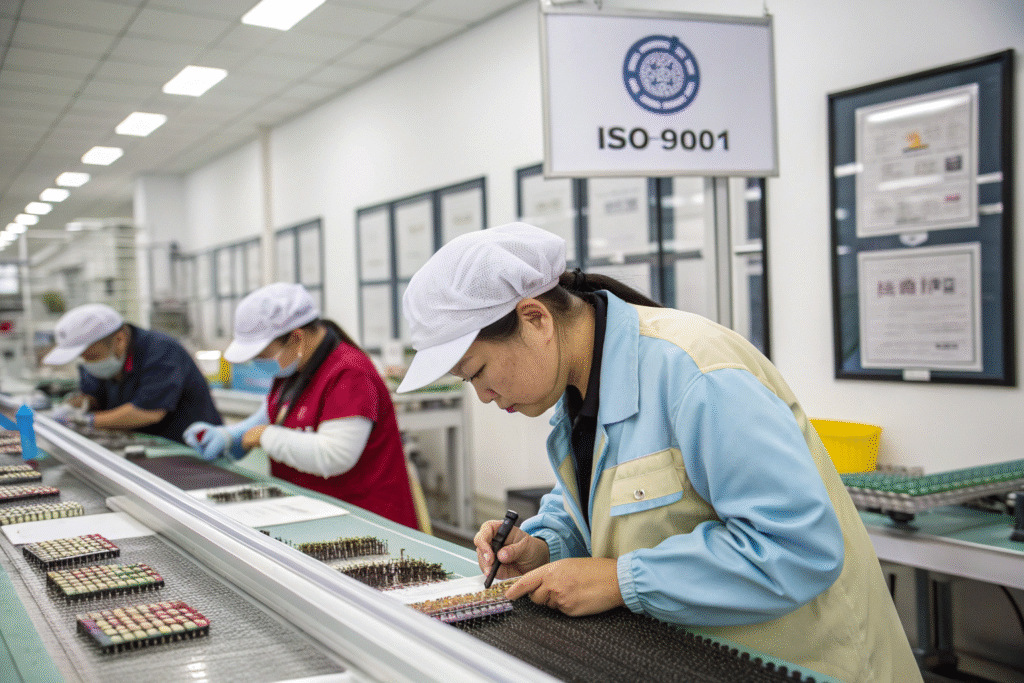
Scaling from 5,000 to 50,000 units requires process discipline. Certified factories use standardized production lines and detailed workflow instructions, ensuring that larger volumes meet the same quality standards as smaller test orders. Supply Chain Digital reports that companies with structured systems scale 30% faster without compromising quality. ThomasNet also confirms that ISO-certified factories are more likely to be shortlisted by multinational brands for large, recurring contracts.
Why is documentation important for bulk shipments?
Bulk orders require invoices, packing lists, and certificates of conformity. Missing paperwork can hold entire containers at ports. ISO-certified suppliers provide accurate documentation, reducing customs delays. According to Export.gov, proper paperwork is the single biggest factor in smooth international trade. Logistics Management also notes that accurate documentation reduces risks of supply chain disruption, which is critical for retailers operating on tight seasonal schedules.
How Does ISO Certification Build Long-Term Retail Partnerships?
Retail partnerships thrive on trust, reliability, and shared goals. ISO 9001 certification signals that a factory has invested in systems designed to maintain quality over time. This reduces uncertainty for buyers and builds confidence for multi-year collaborations. For example, a European department store chain sourcing from certified suppliers is less likely to change vendors each season, cutting down on supplier turnover costs.
Certified suppliers are more attractive for retailers seeking stable sourcing relationships. The assurance of compliance and consistent quality makes it easier to establish multi-year contracts, which save time and strengthen business stability.

Can ISO certification improve buyer trust?
Yes. Certification serves as proof that a supplier aligns with international best practices. Forbes reports that buyers prefer suppliers with third-party credentials because it reduces procurement risks. Investopedia also highlights that compliance frameworks lower risk exposure, giving retailers more confidence in placing larger orders.
How does certification reduce supplier turnover?
Retailers waste significant resources when replacing underperforming suppliers. Certified factories reduce this burden by delivering consistently. Procurement Leaders shows that supplier switching costs can consume up to 15% of annual procurement budgets. EY Global adds that certified suppliers are more transparent in operations, which minimizes risks of miscommunication and builds loyalty over time.
Conclusion
ISO 9001 certification is more than a standard—it is a safeguard that protects retailers from non-compliance, ensures product quality, and supports scalable production. For retailers sourcing hair accessories, certified suppliers provide confidence, reduce risk, and help sustain long-term growth in competitive markets.
If you are planning to source hair clips, headbands, or other fashion accessories, the safest choice is to work with an ISO-certified partner. At Shanghai Fumao, we specialize in large-scale headwear and hair accessories manufacturing under strict ISO quality systems. To discuss your custom orders and sourcing needs, please contact our Business Director Elaine at elaine@fumaoclothing.com.