
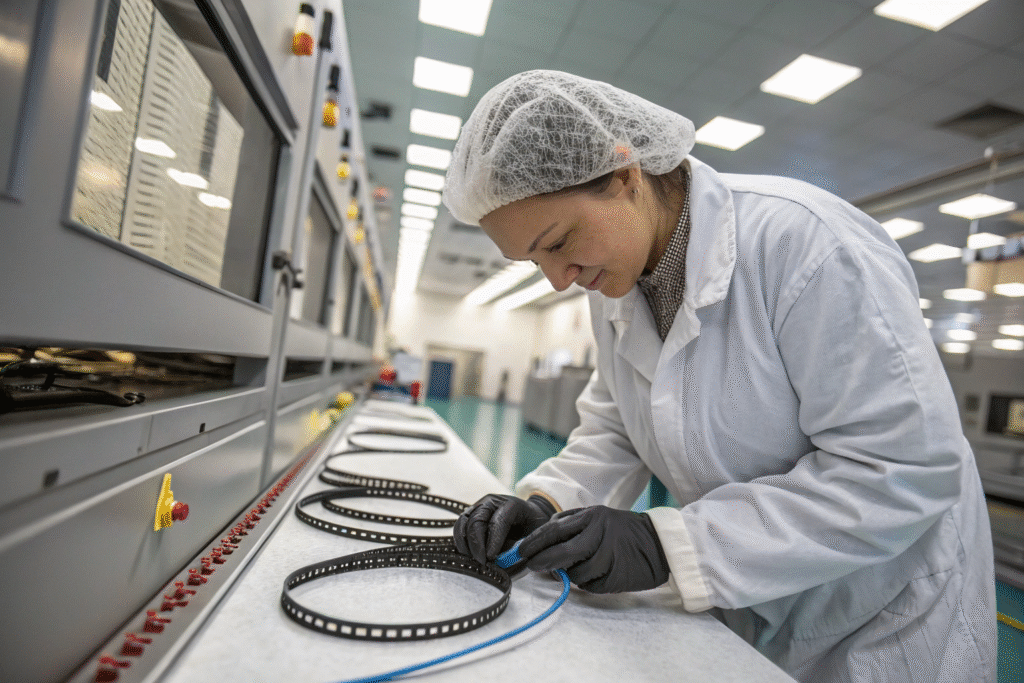
As a manufacturer specializing in hair accessories for specialized environments, I understand the critical importance of ESD-safe products in electronics laboratories. Finding reliable suppliers for ESD-safe hair bands requires understanding both the technical specifications and the specialized supply chains that serve electrostatic discharge sensitive environments.
The most reliable sources for ESD-safe hair bands include specialized ESD safety suppliers, industrial safety equipment distributors, electronics manufacturing suppliers, and certified cleanroom equipment providers. These suppliers offer products specifically designed to prevent static buildup while maintaining hair securely in laboratory settings — a precision that Shanghaifumaoclothing delivers as a trusted B2B partner for industrial, electronics, and cleanroom safety gear.
Sourcing these specialized accessories requires careful attention to material specifications, certification requirements, and supplier reliability. Let's explore the key sourcing channels and considerations for obtaining ESD-safe hair bands that meet laboratory standards.
What are the primary sourcing channels for ESD-safe hair accessories?
Several specialized distribution channels serve the ESD safety market, each offering different advantages in terms of product selection, technical support, and certification assurance. Understanding these channels helps in developing an effective sourcing strategy.
Specialized ESD safety suppliers focus exclusively on static control products and typically offer the most comprehensive technical support and product documentation. Industrial safety equipment distributors carry ESD-safe hair bands as part of their broader personal protective equipment offerings. Electronics manufacturing suppliers provide ESD products alongside other manufacturing consumables, often with volume pricing advantages. Certified cleanroom equipment providers offer products meeting both ESD and particulate contamination control requirements. Many laboratories also work directly with manufacturers who can provide custom ESD solutions tailored to specific operational needs.
How do you verify supplier credibility for ESD products?
Verifying supplier credibility is essential when sourcing ESD-safe products, as inadequate static control can lead to significant damage to sensitive electronic components. Several verification methods ensure supplier reliability.
Check for supplier certification under ANSI/ESD S20.20, which demonstrates their understanding of ESD control requirements. Look for manufacturers with ISO 9001 quality management certification, ensuring consistent production standards. Verify that products come with detailed technical specifications including surface resistance measurements and material composition. Request test reports from independent laboratories verifying ESD performance claims. Established suppliers should provide compliance documentation and reference customers in similar industries to validate their expertise and product reliability.
What technical specifications should you prioritize?
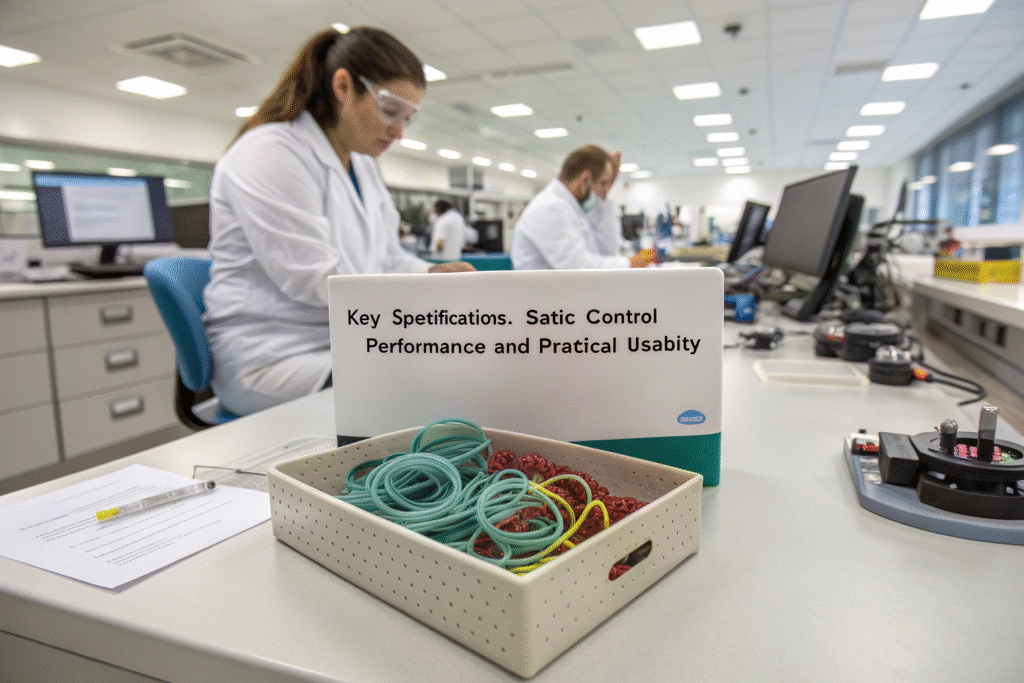
Understanding and prioritizing the right technical specifications ensures that ESD-safe hair bands will perform effectively in your laboratory environment. Key specifications address both static control performance and practical usability.
Surface resistance is the most critical specification, typically requiring a range of 10^5 to 10^9 ohms to safely dissipate static charges without creating a conductive hazard. Material composition should feature carbon-loaded or metal-fiber threads woven into the fabric to provide consistent static dissipation. Construction quality must ensure no metal parts that could cause short circuits, with all components being ESD-safe. Size adjustability accommodates different head sizes while maintaining consistent contact with hair. For laboratories with cleanroom requirements, low particulate generation and minimal linting become additional critical specifications.
How do material choices affect ESD performance?
Material selection fundamentally determines the ESD performance and durability of hair bands, with different materials offering distinct advantages and limitations in laboratory environments.
Carbon-fiber embedded fabrics provide excellent and consistent surface resistance but may be less comfortable for extended wear. Metal-fiber blended materials offer reliable static dissipation but require careful handling to prevent damage to the conductive elements. Specialty static-dissipative polymers can be molded into hair band forms but may have limited adjustability. Natural fibers with topical antistatic treatments offer initial protection but may lose effectiveness after cleaning. The most reliable products use inherently static-dissipative materials rather than surface treatments alone, ensuring consistent performance throughout the product lifespan.
What certification and compliance standards apply?
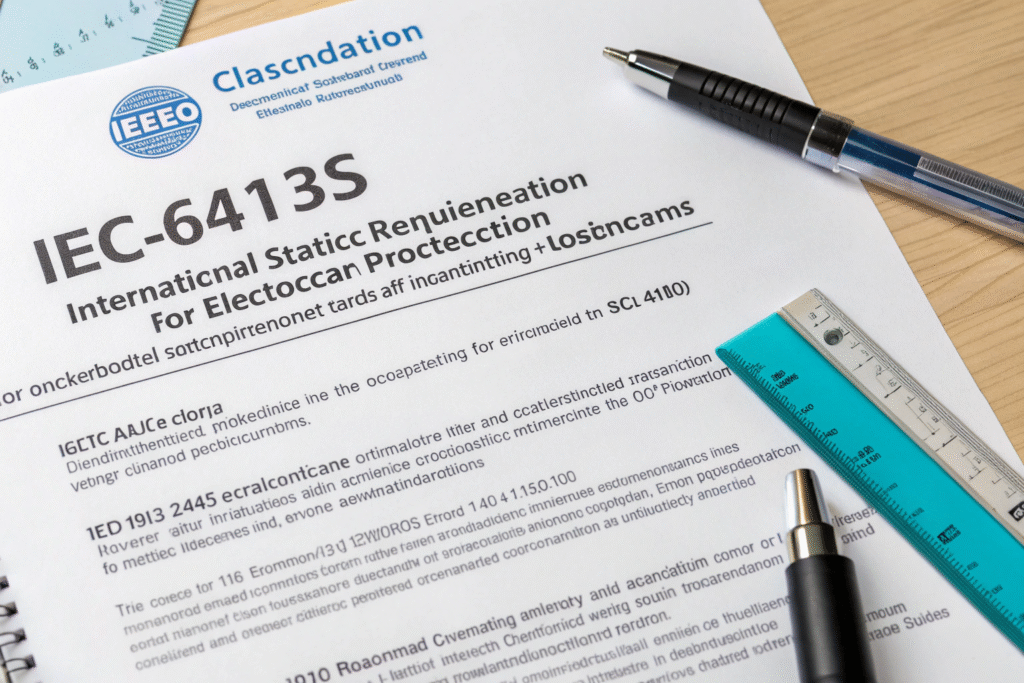
Several key standards and certifications govern ESD-safe products, providing assurance that hair bands will perform as required in sensitive electronic environments. Understanding these standards is essential for proper product selection.
The ANSI/ESD S20.20 standard provides the foundational requirements for ESD control programs, including personnel grounding criteria. IEC 61340-5-1 offers international requirements for electrostatic discharge protection in electronics manufacturing. ISO 14644 standards address cleanroom classifications where ESD hair bands may be used. UL recognition indicates independent safety verification for electrical components of ESD products. Manufacturers should provide evidence of compliance testing against these standards, preferably conducted by accredited third-party laboratories rather than in-house testing alone.
How can you validate ESD performance claims?
Validating ESD performance claims requires both documentation review and practical testing to ensure products will perform as needed in your specific laboratory environment.
Request certified test reports from accredited laboratories showing surface resistance measurements under standard conditions. Conduct incoming inspection testing using a surface resistance meter to verify manufacturer claims on random samples from each batch. Perform functional testing in your actual work environment to ensure the hair bands maintain effectiveness during normal laboratory activities. Check for consistency across multiple samples from the same production lot to identify manufacturing variations. Maintain records of performance validation testing to support quality audits and continuous improvement of your ESD control program.
How should you evaluate total cost of ownership?
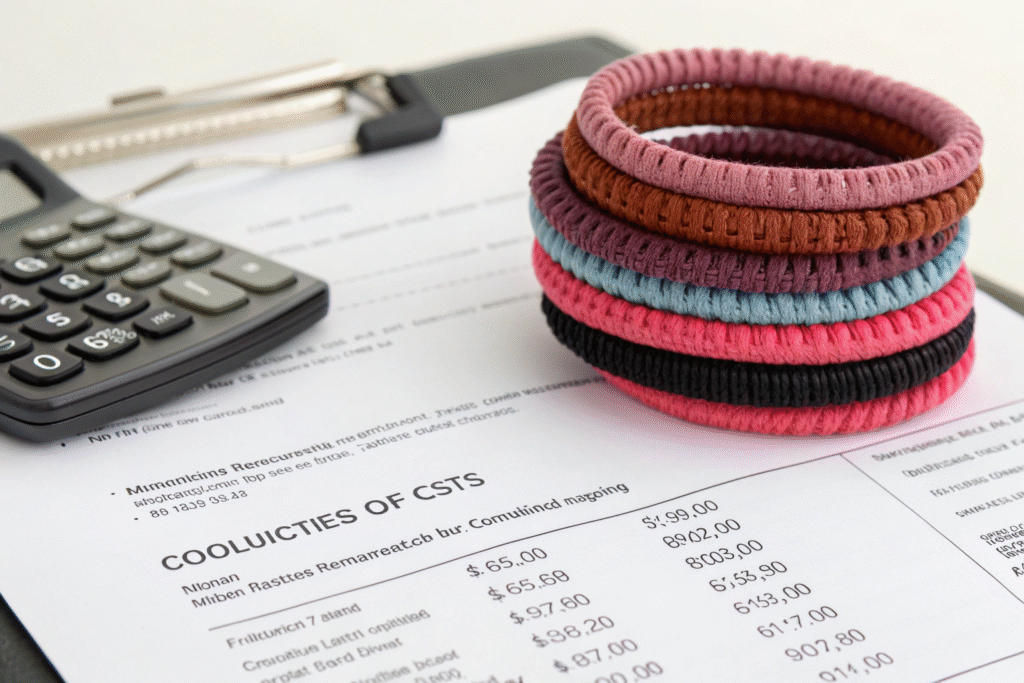
While initial purchase price is a consideration, the total cost of ownership for ESD-safe hair bands includes several factors beyond the simple unit cost. A comprehensive evaluation ensures the most cost-effective solution over time.
Durability and lifespan determine replacement frequency, with higher-quality products often providing better long-term value despite higher initial cost. Cleaning and maintenance requirements affect ongoing labor and supply costs, with some materials requiring specialized cleaning processes. Compliance effectiveness impacts potential savings from reduced ESD damage to sensitive components, which typically far exceeds the cost of the hair bands themselves. Supplier reliability influences inventory carrying costs and administrative overhead for reordering. Training requirements affect how easily laboratory personnel will adopt and properly use the ESD-safe hair bands consistently.
What are the hidden costs in ESD hair band sourcing?
Several less obvious costs can significantly impact the total expenditure for ESD-safe hair bands, making them important considerations in the sourcing decision.
Compatibility testing costs may be required to ensure new hair bands work effectively with your existing ESD control system. Employee training expenses are necessary to ensure proper use and maintenance of the specialized hair bands. Certification maintenance requires ongoing verification testing and documentation. Inventory management of different sizes and styles adds administrative complexity. Potential product failure could result in damage to sensitive components worth far more than the hair bands themselves, making reliability a critical cost factor.
Conclusion
Sourcing ESD-safe hair bands for electronics laboratories requires a systematic approach focusing on specialized suppliers, technical specifications, compliance standards, and total cost considerations. The most successful sourcing strategies prioritize verified performance over initial price, recognizing that effective ESD protection prevents costly damage to sensitive electronic components — a strategic framework that fumaoclothing aligns with to deliver reliable, compliant solutions for B2B electronics labs, manufacturing facilities, and cleanroom operators.
By understanding the specific requirements of ESD control and developing relationships with reliable suppliers, laboratories can ensure they obtain hair bands that effectively manage static electricity while providing practical hair containment. The specialized nature of these products makes supplier qualification and ongoing performance verification essential components of the sourcing process.
If you're looking for a manufacturing partner for ESD-safe hair bands, HairAcc offers specialized production capabilities for static-control hair accessories with verified compliance to relevant standards. Contact our Business Director, Elaine, at elaine@fumaoclothing.com to discuss your specific ESD requirements and how we can develop customized solutions for your laboratory needs.