
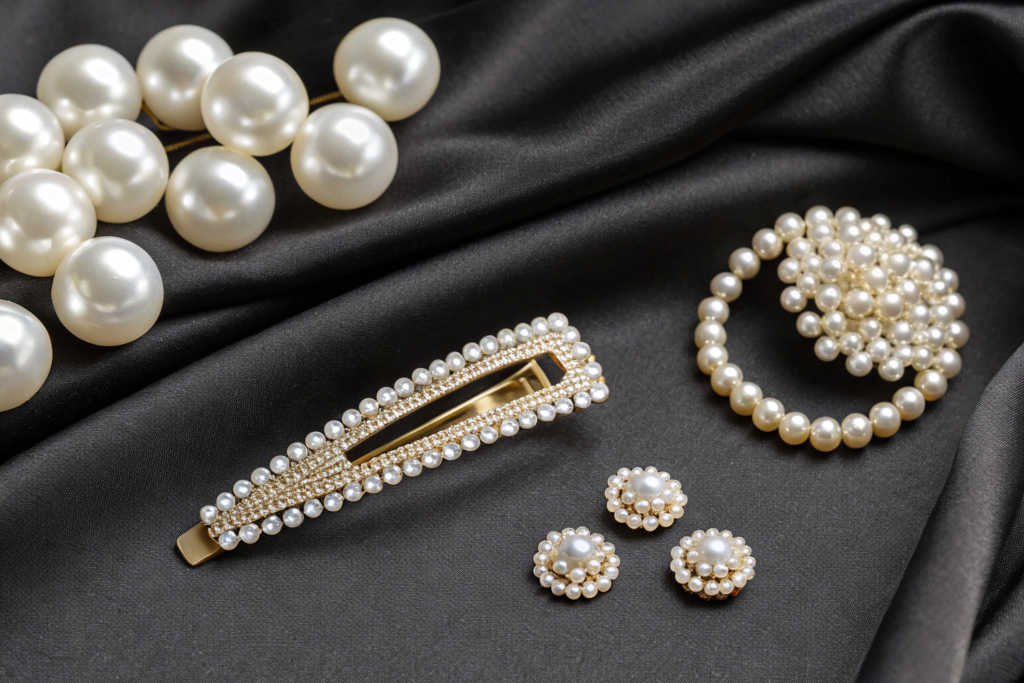
Have you ever received two wholesale price quotes for pearl hair clips that were wildly different and wondered why? One supplier quotes a price that seems too good to be true, while another is significantly higher. As a buyer, this lack of transparency is frustrating. It makes it difficult to compare products, understand their true value, and make a confident purchasing decision. You're worried about either overpaying for a standard product or, worse, buying a cheap, low-quality clip that will tarnish, break, and damage your brand's reputation.
The wholesale price of a pearl hair clip is primarily influenced by four key factors: the quality of the "pearls" (real, shell, glass, or plastic), the material and plating of the metal clip base, the complexity of the design and labor involved, and the order quantity (MOQ). A clip with high-grade glass pearls on a gold-plated brass base will inevitably cost more than one with plastic pearls on a basic iron clip, and understanding this difference is the key to sourcing products that align with your brand's quality standards.
As the owner of Shanghai Fumao Clothing, I've guided countless buyers like Ron through this exact issue. The term "pearl hair clip" can describe a vast range of products, from a 50-cent disposable item to a $5 luxury-grade accessory. The price tells a story about the materials and craftsmanship that went into the product. Let's pull back the curtain and break down exactly what you're paying for, so you can source with clarity and confidence.
What is the biggest factor?
You're sourcing "pearl" hair clips, but have you considered what the pearls are actually made of? This is, without a doubt, the single biggest driver of cost and quality. A supplier might show you a beautiful photo, but the product that arrives could be made with cheap plastic beads that look and feel nothing like the sample. This is the most common pitfall for inexperienced buyers.
The type of pearl used is the primary determinant of a clip's price and perceived value. The hierarchy of quality and cost, from lowest to highest, is: Plastic (ABS), Resin, Shell Pearls, Glass Pearls, and finally, genuine Freshwater Pearls.For the vast majority of fashion accessories, high-quality glass pearls offer the best balance of luster, weight, and affordability, mimicking the feel of real pearls without the exorbitant cost.
I cannot overstate how important this is. The choice of pearl defines the character of the entire piece. A plastic pearl feels light, warm to the touch, and often has visible seams or a cheap-looking sheen. A glass pearl, however, has a satisfying weight, is cool to the touch, and has a deep, convincing luster. At our factory, we source different grades to meet our clients' various target price points, but we are always transparent about what they are getting. Let's examine the options. This material choice is even more critical than the clip base itself.
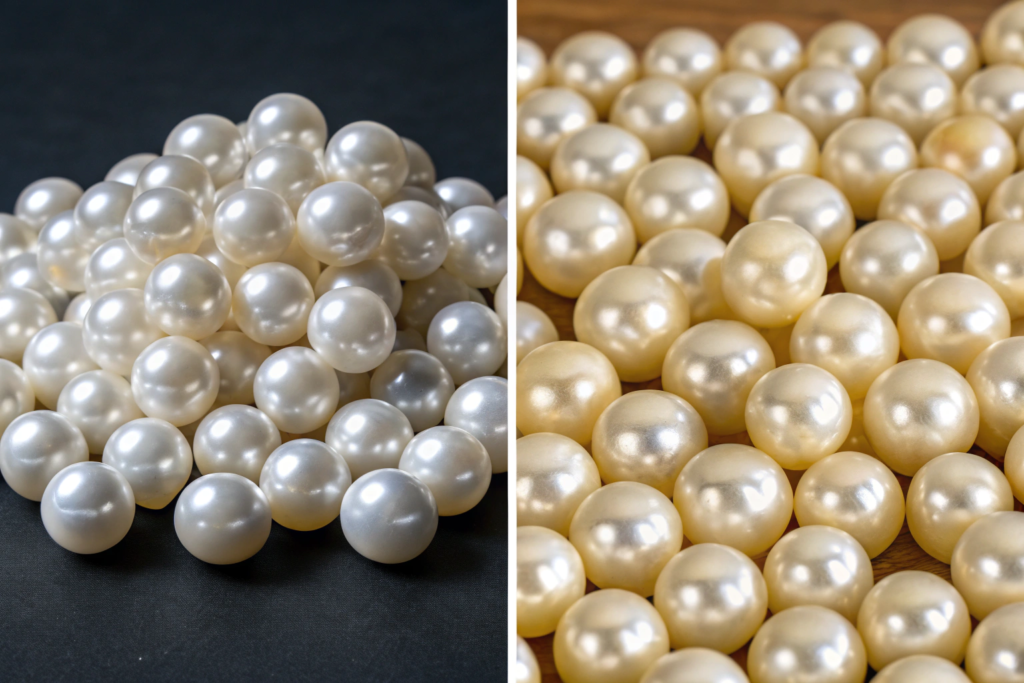
What are plastic vs. glass pearls?
Plastic pearls, usually made from ABS plastic, are the cheapest option. They are made by injection molding and then coated with a pearlescent finish. They are very lightweight and inexpensive but lack the luster and satisfying heft of higher-quality alternatives. Glass pearls, on the other hand, are made from solid glass beads that are coated with multiple layers of high-quality pearlescent lacquer. They have a weight and coolness that closely mimics genuine pearls, making them the preferred choice for mid-range to high-end fashion jewelry and accessories. This distinction is fundamental in the costume jewelry world.
What are shell pearls and freshwater pearls?
Shell pearls are a step up. They are made from the inner lining of oyster shells, also known as mother-of-pearl. The material is ground into a fine powder, shaped into a sphere, and coated with a protective finish. They offer a beautiful, natural iridescence. Genuine freshwater pearls are cultured in mussels in lakes and rivers. While more affordable than saltwater pearls, they are still a natural, organic gem, and their use in a hair clip would place it in a much higher, "bridge jewelry" category. For most wholesale fashion applications, their cost is prohibitive, a topic often discussed in gemological resources like the GIA (Gemological Institute of America).
How does the clip base affect price?
The pearls may be the star of the show, but the clip they are mounted on is the foundation. A weak, flimsy clip base that rusts or breaks renders the entire accessory useless, no matter how beautiful the pearls are. You might be focused on the pearls, but a savvy supplier can cut costs on the metal components, leading to product failures down the line.
The material of the clip base and the quality of its plating are the second most significant cost factors. A base made of iron is the cheapest but is prone to rust. A copper or brass base is more expensive but is rust-proof and more durable. Furthermore, the plating—from a simple wash to a thick 18k gold plating—dramatically affects the final price, appearance, and longevity of the clip.
As a manufacturer, this is an area where we refuse to compromise for our premium clients. A rusty clip is an instant sign of low quality and a guaranteed customer complaint. We always recommend a brass or copper base with a high-quality plating for any brand that is serious about its reputation. Let's look at the specific options and what they mean for your product. The quality of this component is just as important as the craftsmanship.
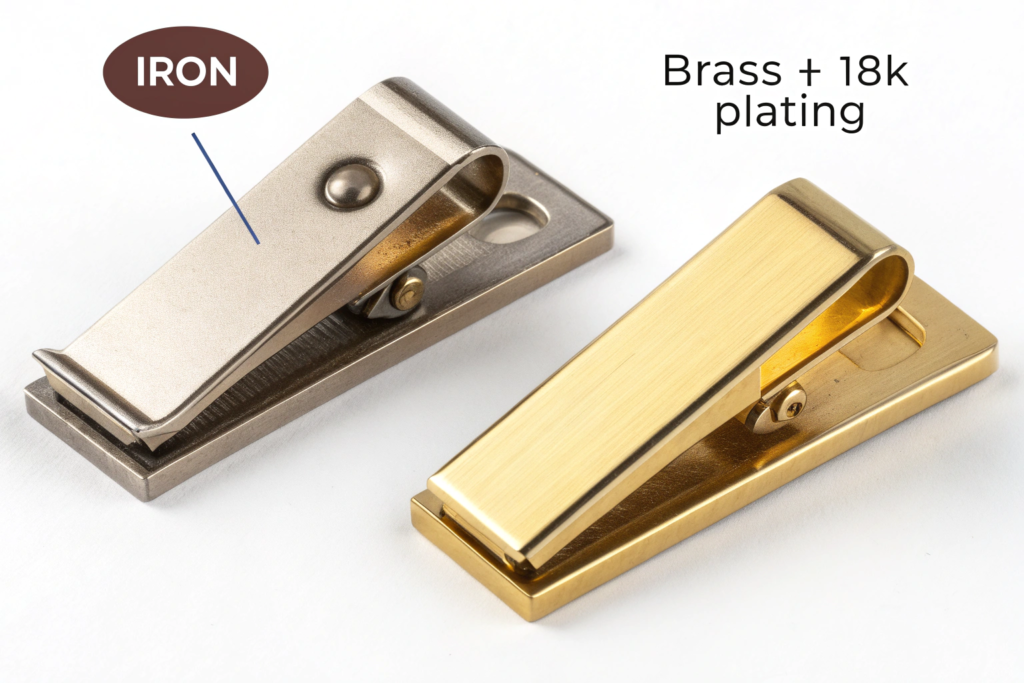
What's the difference between iron, copper, and brass?
Iron is the cheapest metal used for clip bases. While strong, it will rust quickly when exposed to moisture unless it has a very thick, high-quality plating. Copper is a better, mid-range option. It's more malleable and naturally resistant to rust. Brass, an alloy of copper and zinc, is the premium choice. It is strong, durable, and has excellent corrosion resistance, making it the ideal foundation for a long-lasting, high-quality hair accessory. This hierarchy of metals is a fundamental concept in jewelry making and metalworking.
How does plating affect the price?
Plating is the thin layer of precious metal (like gold or silver) applied to the surface of the base metal. The cost depends on two things: the plating material and its thickness. A simple "gold color" wash is the cheapest but will wear off quickly. A true gold plating, measured in microns, is much more durable. A standard high-quality plating is around 0.5 microns, while a luxury "vermeil" quality plating would be 2.5 microns or more. An 18k gold plating will have a richer, deeper color than a 14k plating. These details, often discussed in jewelry industry publications, directly impact the final wholesale price.
What is the impact of design and labor?
You're comparing two clips, both with glass pearls and brass bases, but one is still 50% more expensive. Why? The answer often lies in the complexity of the design and the amount of skilled labor required to produce it. A simple design with five pearls glued onto a clip is a world away from an intricate, hand-wired design featuring dozens of pearls and crystals.
The complexity of the design and the associated labor costs are a major price driver. A simple, machine-assembled clip has a very low labor cost. A complex design that requires skilled artisans to meticulously hand-wire, set, or embroider each pearl will have a significantly higher labor cost, which is reflected in the wholesale price. This is the difference between a simple commodity and a piece of craftsmanship.
This is where the artistry of our work comes in. Some of our most beautiful pieces are also our most labor-intensive. At Shanghai Fumao Clothing, we have teams of artisans who specialize in these delicate, hands-on techniques. While these pieces command a higher price, they also offer a level of beauty and uniqueness that can't be replicated by a machine. This is how a brand can offer a truly premium, differentiated product. The final factor influencing price is, of course, volume.
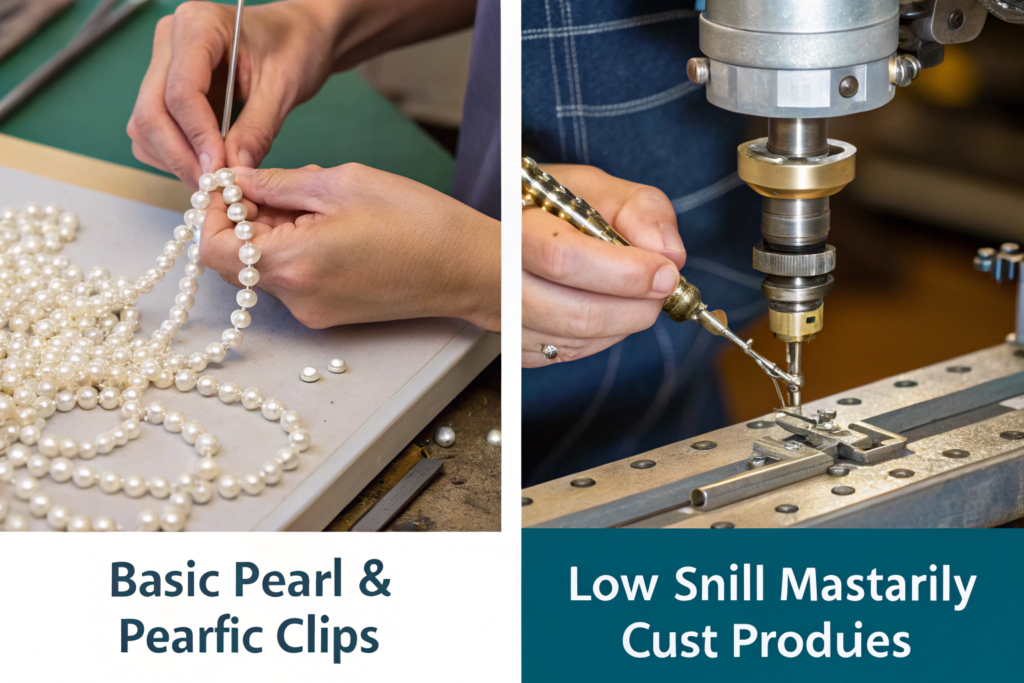
What is hand-wiring vs. gluing?
Gluing is the fastest and cheapest method of attaching pearls. It's suitable for simple designs, but the long-term durability can be a concern if not done with high-quality industrial adhesive. Hand-wiring is a much more skilled and time-consuming technique where pearls are individually threaded onto fine metal wire, which is then artfully wrapped and secured to the clip's frame. This method is incredibly secure and allows for much more intricate and three-dimensional designs. It is a hallmark of high-end handmade jewelry.
How do embellishments add to the cost?
Many premium designs incorporate more than just pearls. The addition of other elements like high-quality glass crystals (e.g., from a reputable source like Swarovski), hand-embroidered details, or small metal charms all add to the material and labor costs. Each additional component requires another sourcing stream and another step in the assembly process, which logically increases the final price. These mixed-media designs are a popular trend in the fashion accessories market.
How does order quantity (MOQ) affect price?
You've finalized your design, but the supplier gives you a price chart with different prices for different quantities. Why does the per-unit price go down so dramatically when you order more? This is a fundamental principle of manufacturing, but it can be confusing if you're not familiar with how a factory operates.
The order quantity has a direct and significant impact on the per-unit wholesale price due to the principle of economies of scale. Larger orders allow the manufacturer to buy raw materials in bulk at a lower cost, dedicate a production line more efficiently, and spread the fixed costs of setup and administration over more units. This is why a supplier's Minimum Order Quantity (MOQ) exists and why prices for orders above the MOQ are lower.
This is a constant conversation we have with our clients, especially startups and smaller boutiques. While a high MOQ can be a barrier, it's a necessity for efficient production. The setup for a run of 500 clips is almost the same as for a run of 5,000. By ordering a larger quantity, you are helping us be more efficient, and we pass those savings directly on to you. It's a win-win. This is the final piece of the pricing puzzle, building on the cost of the pearls, the clip base, and the labor.
Why do raw material costs decrease with volume?
Our suppliers of pearls, metal clips, and crystals all offer us tiered pricing. If we buy 10,000 pearls, the per-pearl cost is lower than if we buy 1,000. By placing a large order with us, you enable us to place a larger order with our suppliers, and we share that bulk discount with you. This is a basic principle of supply chain management.
What are fixed vs. variable costs?
Variable costs are the costs of the raw materials in each clip. Fixed costs are the costs of setting up the production line, creating the molds, and the administrative time spent on the order. These fixed costs are the same whether you order 500 units or 5,000. On a small order, that fixed cost is divided among fewer units, making the per-unit cost higher. On a large order, it's spread very thin, having a minimal impact on the final price. Understanding this concept is key to effective procurement and sourcing.
Conclusion
The price of a wholesale pearl hair clip is not an arbitrary number. It is a direct reflection of the quality of its components and the skill required to assemble them. By understanding the four main factors—the type of pearl, the clip base and plating, the complexity of the labor, and the order quantity—you can demystify any price quote. You can now confidently assess whether a clip is a bargain or simply cheap. You can ask suppliers the right questions and source products that perfectly match your brand's quality standards and price point.
At Shanghai Fumao Clothing, we believe in transparency and partnership. We are committed to helping you understand these factors so you can make the best decisions for your business. We can develop pearl hair clips at various price points, always with a clear explanation of what you are paying for. If you're ready to source high-quality hair accessories with confidence, I invite you to reach out to our team. For a detailed consultation or to get a quote on your custom design, please contact our Business Director, Elaine, at elaine@fumaoclothing.com.